


Explore over 15,000 combinations. Choose your size, colours, options and locations, and watch your pool take shape in 3D.
Home » Uncategorized » Pool Safety in NSW: Why the Outback Plunge Pool Qualifies as a Spa Pool
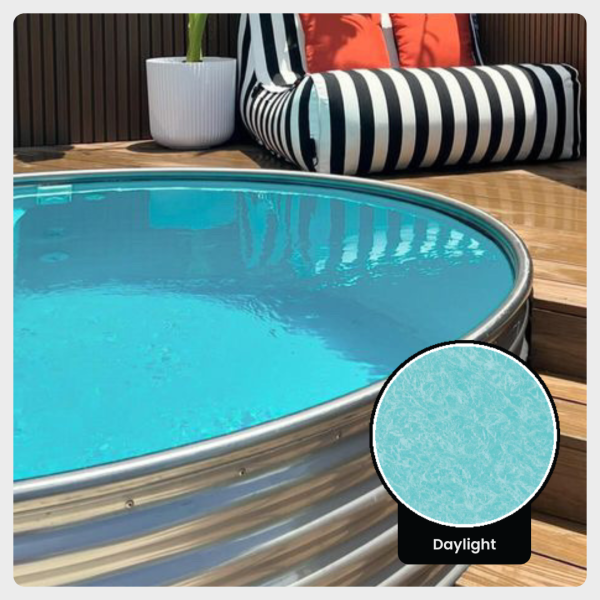
Across New South Wales, confusion persists around what makes a pool compliant when using a lockable cover instead of a fence.
Two myths dominate:
Both are false. The NSW legislation makes it clear that classification, construction integrity, and child-resistance are what matter — not water capacity or material type.
The Swimming Pools Act 1992 and the Swimming Pools Regulation 2018 (Regulation 9) define a spa pool as a body of water used primarily for relaxation or hydrotherapy, often with heating, jets, or compact construction.
Nowhere in the Act or Regulation does it state a minimum or maximum volume of water for classification or compliance.
That means it doesn’t matter whether a spa holds 1,000 L or 10,000 L — if its design, structure, and purpose match that of a spa, it’s treated as one under the law.
By this measure, the Outback Plunge Pool clearly meets the definition of a spa pool:
In contrast, many swim spas — which are universally accepted as spa pools — actually hold significantly more waterthan an Outback Plunge Pool. A standard swim spa often ranges from 5,000 L to 8,000 L, while many Outback Plunge Pools contain considerably less.
If swim spas of that size are treated as compliant spa pools, then it is logically and legally consistent that the smaller Outback Plunge Pool should also be recognised under the same classification.
A second misconception is that a spa pool cover must be a rigid “hard lid” to be compliant. This belief is not supported by the legislation.
Regulation 9 of the Swimming Pools Regulation 2018 states that a compliant spa cover (or structure) must:
Crucially, the regulation does not specify that the cover must be made of solid or rigid material such as plastic, metal, or fiberglass.
It allows for any construction — including mesh or flexible materials — so long as the structure meets the performance requirements: that is, it must resist lifting, support static weight, and fully prevent access to the water by a small child.
This means a tensioned mesh cover, when correctly designed, can absolutely be compliant if:
Compliance is about outcome, not material — the law tests safety performance, not what the cover is made of.
The Outback Plunge Pool combines modern design with safety compliance through a lockable, child-resistant cover system that satisfies Regulation 9. Its features include:
By meeting these criteria, the Outback Plunge Pool’s cover acts as an effective safety barrier, equivalent to or exceeding the protective function of a fence.
The removability of the Outback Plunge Pool further reinforces its classification as a spa pool rather than a fixed swimming pool.
NSW law consistently distinguishes between permanent installations (which must have fences) and relocatable or portable pools (which may rely on alternative access restrictions).
Because the Outback Plunge Pool can be drained, moved, or repositioned, it sits squarely in the same category as portable and spa-style products — all of which can legally use lockable covers in lieu of fencing, provided the cover meets Regulation 9.
It’s time to replace old myths with legislative facts:
The Outback Plunge Pool fully aligns with these legal and safety benchmarks — offering a compliant, portable, and elegant solution for safe, low-impact pool enjoyment in New South Wales.